Roof Leak Repair in Decatur, GA: What to Do Before a Small Leak Becomes a Big Problem
Discover how to address roof leaks in Decatur, GA before minor issues become major headaches. Act now to protect your home.
Quick Answer: Most roof leaks we repair in Decatur started as something small that a homeowner noticed months earlier. A faint ring on the ceiling, a musty smell in a closet, a drip that only shows up during heavy rain. The water you see inside is almost never directly below the hole in the roof, which is why guessing leads to the wrong repair. If you have signs of a leak, catch the water, take a few photos, stay off the roof, and get the source found by someone who can walk it safely. Caught early, this is usually a repair measured in a few hundred dollars. Left alone through a Georgia winter, the same leak can turn into rotted decking, ruined insulation, and drywall work.
What a Roof Leak Looks Like From Inside Your Home
Water travels. It runs along the underside of your decking, follows a rafter, soaks into insulation, and finally shows up at the lowest point it can reach. That point might be ten feet away from where the water actually got in.
Here is what homeowners usually notice first:
A yellow or brown ring on a ceiling or at the top of a wall
Paint that is bubbling, peeling, or looks slightly swollen
A musty smell in a closet, an upstairs bedroom, or the attic
Drips or dampness that only appear during heavy or wind driven rain
Dark streaks on the wood in your attic
Insulation that looks flattened or discolored in one spot
A bathroom or hallway light fixture holding water
That last one is not a maintenance item. If water is in a light fixture or an electrical box, shut off the breaker to that circuit and get it looked at right away.
Where Decatur Roof Leaks Usually Start
After years of repairs on homes around Decatur, the same handful of spots account for most of what we find.
Pipe boots. The rubber collar around your plumbing vent pipes is the single most common leak we find. The rubber dries out and cracks in the Georgia sun, usually around the eight to twelve year mark, and then every rain runs straight down the pipe into the ceiling below. The shingles around it can look perfect.
Roof vents and attic fans. Seals and gaskets fail the same way the boots do.
Flashing at chimneys, skylights, and walls. Anywhere the roof meets something vertical, a metal flashing is doing the work. When it loosens, pulls away, or was caulked instead of properly installed, water gets behind it.
Valleys. Where two roof planes meet, water concentrates. Debris collects there and holds moisture against the shingles.
Nail pops. Shingle nails back out over time and lift a small gap.
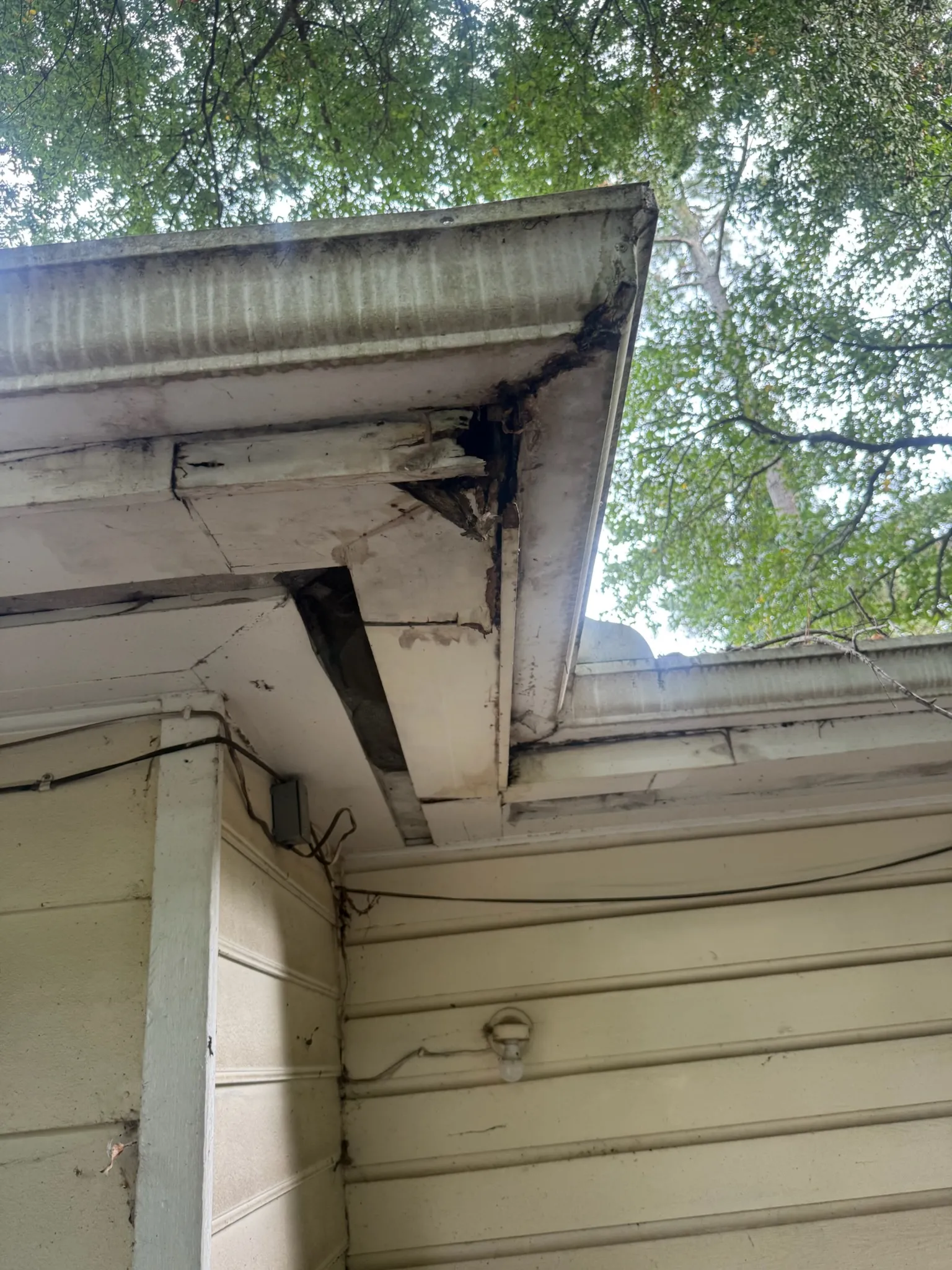
The roof edge. If there is a gap between your roof decking and fascia, or the drip edge is missing, rain runs behind the gutter instead of into it.
Clogged gutters. This is the one that bites Decatur especially hard. The oaks and pines in neighborhoods like Oakhurst, Winnona Park, East Lake, and Belvedere Park fill gutters every fall. When the gutter backs up, water sits against the roof edge and works its way under the shingles.
Right now is the season for that last one. Leaves are down, gutters are full, and Georgia's winter rain is steady rather than dramatic. Steady rain is actually worse for finding leaks, because the water has time to soak in instead of running off.
What to Do in the First 24 Hours
Catch the water and move your things. Put a bucket under the drip and move furniture, rugs, and electronics out of the area.
Relieve a bulging ceiling. If a section of drywall is sagging and holding water, poke a small hole at the lowest point with a screwdriver and let it drain into a bucket. A controlled hole is a much smaller repair than a collapsed ceiling.
Take photos and note the timing. Photograph the stain, the drip, and anything you can see in the attic. Write down whether it leaks only during rain, only during wind driven rain, or all the time. That timing tells a roofer a lot about where to look.
Stay off the roof. Wet shingles are slick, and the damaged area is the part most likely to give way under your weight. This is not worth the risk.
Check your attic if you can get there safely. Look for wet wood, daylight, or damp insulation. Note the location relative to a room below.
Call for an inspection. The goal of the first visit is to find the actual source, not to patch the first thing that looks wrong.
What Not to Do
Do not seal it from the inside. Caulk or spray foam applied to the underside of the decking traps water in the wood and hides the problem while the rot continues.
Do not have someone tar over the area. A smear of roof cement over a cracked pipe boot buys a season at most, and it makes the real repair messier and more expensive later.
Do not wait for the next storm to see if it happens again. It will, and the wood will be wetter when it does.
Why Waiting Is the Expensive Choice
A cracked pipe boot is a small, straightforward repair. The problem is what the water does between the day it starts and the day it gets fixed.
Water sitting on roof decking softens the wood. Soft decking has to be cut out and replaced, which means the shingles above it come off too. Wet insulation stops insulating and has to be removed. Damp drywall stains, then sags, then needs patching, texturing, and painting. Give it long enough in a dark attic and you are dealing with mold remediation on top of all of it.
The repair does not get harder in a straight line. It stays small for a while, then it jumps.
How Roofit Restoration Finds and Fixes a Leak
We start where the water shows up, then work backward. We look at the stain inside, get into the attic where we can, and trace the path up to the entry point rather than assuming the roof is bad directly overhead.
We walk the roof and check the usual suspects first. Pipe boots, vents, flashing, valleys, nail pops, and the roof edge. Most leaks are found in one of those.
We check how far the water got. Soft decking, wet insulation, and stained framing tell us whether this is a surface repair or whether there is damage underneath that has to come out.
We show you what we found. Photos from the roof and the attic, so you are looking at the same thing we are instead of taking our word for it.
We fix the cause, not the symptom. New boot, new flashing, new decking where it is needed, sealed correctly so water goes where it is supposed to go.
We give you a written quote before any work starts. You will know the number and the scope up front.
If you want a real example of how far roofline water damage can travel, our write up on fascia, soffit and gutter repair in Decatur walks through a full repair from start to finish.
Is a Leak a Repair or a Sign You Need a New Roof?
One leak in an otherwise sound roof is a repair. Almost always.
The conversation changes when we find several leaks at once, shingles that are curling or losing granules across the whole roof, decking that is soft in more than one area, or a roof that is simply at the end of its life. In that case, repairing one spot means you will be back on the phone after the next few storms.
We will tell you which situation you are in. If you are weighing the decision now, our guide on whether to repair or replace your roof lays out what to look at.
Frequently Asked Questions
How do I find where my roof is leaking?
Start inside. Note exactly where the water shows up and when it happens, then check the attic above that area for wet wood or damp insulation. Keep in mind that water travels along the decking and rafters, so the entry point on the roof is often several feet away from the stain on your ceiling. Tracing it accurately usually takes getting on the roof, which is why we recommend an inspection rather than guesswork.
What is the most common cause of a roof leak?
On Decatur homes, cracked pipe boots around plumbing vents are the most common cause we find. The rubber dries out and splits after about eight to twelve years in the Georgia sun, and the surrounding shingles often look completely fine.
Can a roof leak be repaired, or do I need a whole new roof?
A single leak on a roof that is otherwise in good shape is a repair. A new roof becomes the better option when there are multiple leaks, widespread shingle wear, or soft decking in several areas.
How much does roof leak repair cost in Decatur, GA?
It depends entirely on the cause and how far the water traveled. Replacing a pipe boot or resealing flashing is a small repair. Replacing rotted decking and the shingles above it costs more. We give you a written quote after a free roof inspection so there are no surprises.
Is it an emergency if my roof is leaking?
It is urgent if water is actively running in, if it is near electrical fixtures, or if a ceiling is sagging. Shut off power to any affected circuit, contain the water, and call us. If the leak is a slow stain that has been there a while, you have a little more time, but it still needs to be looked at before it spreads.
Will a tarp stop my roof from leaking?
A properly installed tarp can protect your home temporarily while you wait on a repair, especially after storm damage. It is a stopgap, not a fix, and it needs to be installed by someone who can do it without creating new damage.
Does Roofit Restoration offer free roof inspections in Decatur?
Yes. We offer free roof inspections across Decatur and Metro Atlanta.
Get a Free Roof Inspection in Decatur
If you have a stain on your ceiling, a drip during heavy rain, or a smell in the attic you cannot place, let us find out where it is coming from before the wood underneath gets involved. Roofit Restoration is a local, Decatur based roofing company handling roof repair in Decatur, GA and across Metro Atlanta.
Call (470) 600-0417 or request your free roof inspection online.
Decatur, GA / Metro Atlanta